No products in the cart.


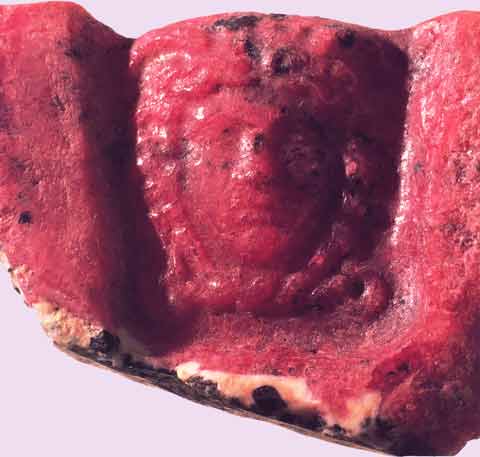
A massive ruby from Tanzania, engraved with a suggestive Roman fa
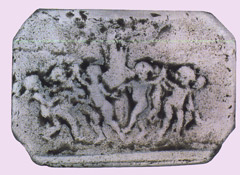
A hyaline quartz plate with a neoclassical scene.
In his masterpiece, “Plinio Il Vecchio” explains that precious stones are made to be engraved, and not merely for decorative purposes. The engraving on the stone triggers a process of historicizing that personalizes it, in the true sense of the word. A gem, engraved with the coat of arms of a family, enters the right to be part of that family, its traditions, its history, its life.
It is known that, in the Rome at the time of Nerone, the powerful who fell into disgrace had very few alternatives to suicide. A necessary step to this sad ritual, was to break their seals. Little echo of these meanings are present in various remains of seals nowadays; though a signature on a sealing wax, with an engraving of some image in relief, maintains a charm all its own.
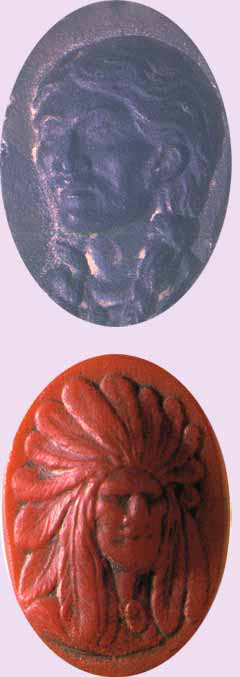
Onyx engraved with the face of an Indian.
On several occasions we have said that Stone Age, that is the time that runs from when man was able to work stones, represents the moment of detachment between the prehistoric times when man did not use tools, and the rise of civilization, where instead man was able to have a full relationship with Nature, upto using it for his own purposes, upto being capable of expressing it thoroughly as it should be. Those rock carvings that after many millennia excite us, were carried out by rubbing a stone on the rock; the same technique that, more or less, has then been adopted to perform incisions on gemstones. Cylinder seals were common in ancient times. A small round perforated cylinder, engraved with a negative relief, would leave a trail along the whole length of the strip of wax when rolling upon it. Such incisions were mythological, religious, allegorical, or would reproduce a face or something written. This special exhibition of figurative art, very much like miniature art, brings attention to that which is small, upto the limit of vision capacity without having to use the magnifying glass. This involves a state of mind and a spiritual attitude that are quite different than those required for figurative arts which necessitate wider horizons. So a picture can be an open window on another floor; a statue can be an intrusion that has materialized from another cultural and time dimension; a monument or a building of great architecture is the reconstruction of an ideal scenery in which we can walk, conditioned by a special atmosphere, commissioned by the designer. Furthermore, we could speak of the great natural scenery, of landscapes and of sunsets, where the designer could be identified in the Great Architect, but we will not go that far. If we watch a miniature, a seal, a tiny incision, we are immediately brought to an introspective state of mind. Alright for the refinement and craftsmanship of the feature; but the atmosphere in which one finds himself immersed is strong and a little sad, because the shadows of passing time, leave only the engraving on the stone unchanged, reminding us of our transience.
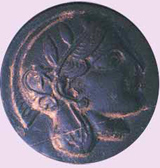
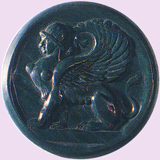
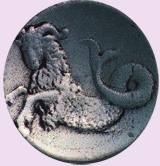
There is a civilization that is not expressed in pictures. Religious considerations forbid Muslims to depict faces and human figures or to impersonate aspects of divinity, hence they have had to hoist their huge expressive winding into architecture and into calligraphy. And what it could be better than to incise passages from the Koran on gemstones? In Western languages there has been some effort of imagination to develop sophisticated monograms, but in this respect no one can compete with Muslim art of calligraphy.
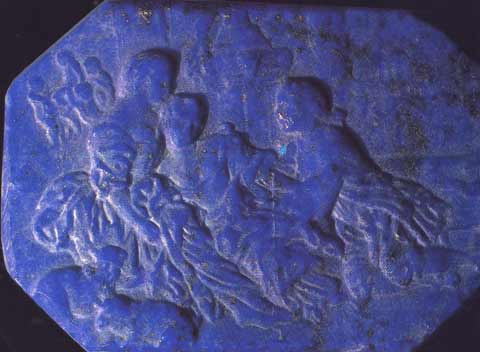
Lapis lazuli plate chiselled with a masterfully executed neoclassical engraving.
I am text block. Click edit button to change this text. Lorem ipsum dolor sit amet, consectetur adipiscing elit. Ut elit tellus, luctus nec ullamcorper mattis, pulvinar dapibus leo.
Engravings on precious stones should not be confused with shell cameos or processing of organic substances such as coral, ivory, bone, tortoise shell and the like. These processes, though performed with skill, do not have the characteristics of “durability” of precious stones, thus do not fall within our field of investigation.
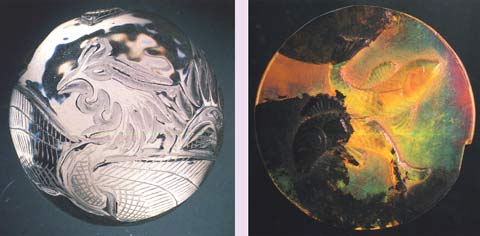
Engravings can be done in high relief or in low relief (that is to say in the “positive” or in the “negative“). Generally the high relief (positive), is performed to be seen as it is, while the bas-relief (negative), is used to give a positive image of a wax seal or the like. In the latter case, the image will be reversed, and any acronyms will be read backwards.
There is also a type of special processing, used in rings to be used in church, in which the outer surface is polished (flat or cabochon), whilst there is an image carved in the inside, visible through transparency. This is an attractive decorative virtuosity, done by those who know how to take into account that particolar anamorphic deformation of the lenticular surface.
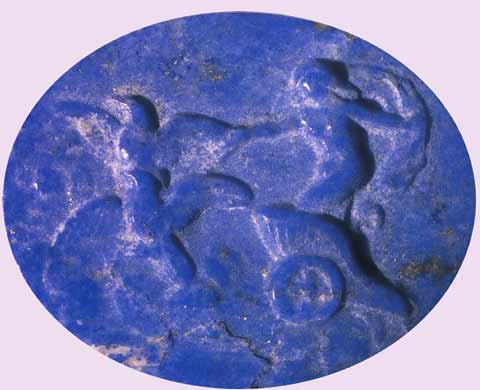
Lapis lazuli with a mythological scene.
The family coat of arms were an apanage of the nobility of times gone by; today they would have very little sense, were it not for an aesthetic whim, so one who does not have a coat of arms can very honestly inventi it himself (even the noblest of all noble families invented their coat of arms thenlseves after all) and have it incised on a cute gemstone without having to spend a fortune on it. In any case, in Italy we have the most talented engravers, for whom an engraved stone is a whim to be on. Naturally, even in this regard the following distinction should be made very clear: pantographs, ultrasound machines and the like can perform automatic stone carvings, at a low cost and with repetition; it is obvious that these industrial processes, excellent for articles of imitation jewelery, have nothing to do with real jewelry. Furthermore, too often we tend to incise materials of little value, hence disqualifying the skill of the engraver.
The ideal are the very hard stones, with a little transparency. Light blue sapphires, yellow sapphires, maybe cut plates, are stones that can be highly valued with engravings, and their hardness preserves them from exploitation for many generations to come.
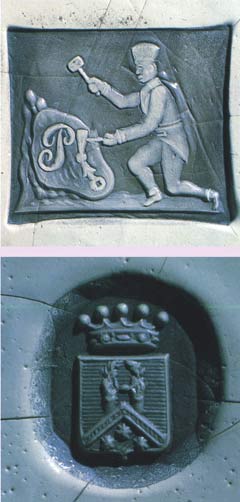
Seal where the engraver performs a playful self-portrait; Under the Severi family crest.