No products in the cart.


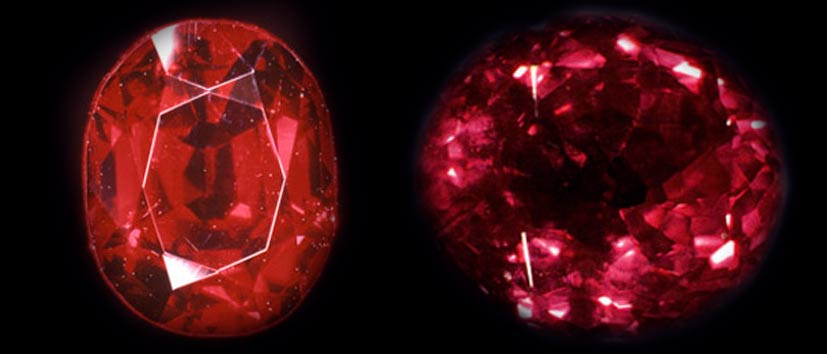
African ruby of about three carats – Ruby from Sri Lanka of ct.4.34. The brilliance of these stones, of a deep pink color, is absolutely terrific.

Journey into a particularly limpid ruby coming from Burma.

A batch of rough rubies
Red. When the light of a star ceases to blind and magma is preparing to solidify, the first color that appears is the red. Even in the rainbow the first color is red. And when the sun sets at down taking with it all the colors, its color is red. Of course, blood is red, and there seems to be nothing more red. Red. As for flowers, poppy and rose; as for fruit, black cherry and the interior flesh of the watermelon; as for vegetables, tomato and bell pepper. Always rounded, always a bit in the shape of the heart. And, as for stones, the ruby. Sure, there is also garnet, zircon, spinel, tourmaline, chrysoberyls, to name only the best known stones, which can have a nice red color. But the red of rubies… turnes any other stones’ red into purple or pink. Unfortunately, the really beautiful rubies, the good quality ones of Burma, are so rare that it can be very hard to see one at all; I’m talking of those stones which have ‘pigeon blood’ colouring. I never slaughtered a pigeon to check the hue of its blood in relation to that of other birds, but it’s weird that it was the pigeon to be chosen; the bird of the olive branch of Noah’s Ark, the symbol of the will of peace; what do you think? Are doves and pigeons different animals? So different must be the color of their bloods? Fine.
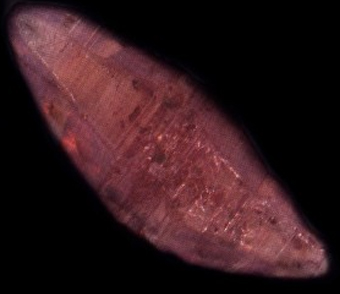
A rare example of a ruby crystal with a perfectly formed crystal outfit (double hexagonal pyramid), even though it is an alluvial discovery.
In India, each shade of ruby has been associated with a hindu god: they have three hundred and sixty hundreds of thousand deities! One could think that there are not so many rubies on earth, no, because such number, with a particular qualitative value, signifying an extremely large amount, beyond ordinary human range, translated into more familiar terms, becomes thirty-six million, a respectable but less impressive sum. We have red, carmine, pigeon blood red, pink, deep pink, red purple, red orange, and that’s it with the hues. Maybe three hundred and sixtyhundred of thousand is a bit too much, but less than ten would be definitely too little. As it so often happens for the most beautiful precious stones, also the geographic extraction area of the finest rubies in the world is plagued with political and social violence that goes beyond western understanding.
The tendency would be to let the state trade the few rubies that are quarried, with open international public tenders open only for the biggest names in the industry. Entry visas for Burma allow you to stay in that wonderful country only for a few days, and it is unthinkable to transit through the mining areas, because rubies are a by-product of these tormented lands especially devoted to poppy cultivation. As usual, we are aware that the road conquered by a stone in order to reach us is tortuous and often fierce, but this we do not fear; it is also for these reasons that precious stones are precious; and when we are dealing with a beautiful ruby, with its captivating ‘primordial blood bath’, with the strength of its cold red flare, with the icy fury of its intimate embers that vibrate something other than flames; when it is with similar gems that we have to deal with, well we can do nothing but get rapt in strong stories.
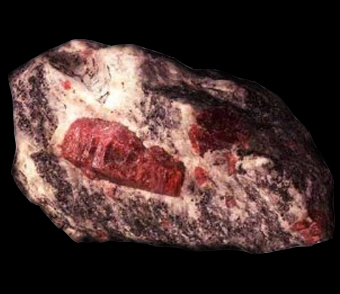
Rough ruby. Note the double hexagonal pyramid structure of the crystal. Currently it is enclosed in the parent rock, but it would be enough to roll it in the river for a few thousand years and the rock becomes sand, while the ruby, tremendously harder, will keep its original form almost intact.
Two friends leave their village to go in search of fortune, and finally find two splendid rubies. And, as in the best of traditions, they swallow them to avoid being robbed. But their servant steels their weapons and incarcerates them, waiting for the rubies. Then cames an outlaw, who realises that these are up to something, so gets ready to butcher the three men. The servant comes forward, and tells the outlaw it is useless to slay them all: if his masters had hidden a few stones, they would have made their servant swallow them, so he might as well open the belly to himself alone. That said, with a sharp blade he cuts his belly open, and offers his guts to the outlaw who leaves upset after examining these them briefly. The two friends return to the village enrich with stones and experience of nobility. The magnanimity they had inherited from an unfaithful servant; the experience from a fierce but not too violent outlaw, they bore wealth inside themselves; now, with the stones concealed, first with their determination to look for something, searching for the stone that was on their way.
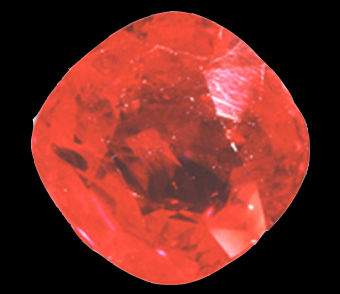
African ruby of about 4ct, with a pleasant orange-red colouring
I would have loved to bring back all the good exotic names that accompanied this Indian fable, which I heard somewhere around Khajuraho many years ago. Other tales tell of giant cobras with fabulous rubies placet on their prefrontal bone regions, and adventure story literature by Salgari is filled with temples containing idols having a ruby on their foreheads that are always tried to be stolen, amidst a thousand dangers and a thousand curses. There is some truth in this. Ruby does indeed represent the ‘third eye’ in certain Eastern tradition: wider aperture than ordinary dimensions. The classic blessing given to those who visit the temple is a red spot on their foreheads; which, precisely, symbolizes the third eye. The color red is used since it would be unlikely to use rubies instead. But rubies are used to wreathe the sacred elephant, just above its eyes, and certain deities, always on their foreheads, just above their eyes.
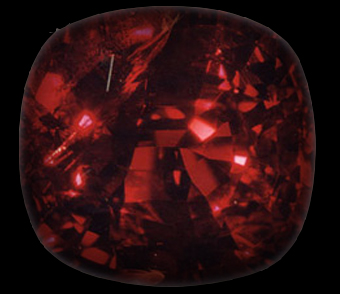
Magnificent Burma ruby of about three carats
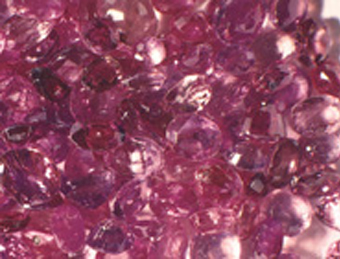
Batch of pink rubies having a native cut.
NOTES
When corundum Al2O3, instead of being absolutely pure and colorless, has traces of chromium oxide, or trivalent iron, it turns red, and is called ruby. Burma’s quality color is due to the abundance of chromium oxide, while the presence of trivalent iron makes up the purple or pink varieties found in Thailand, Sri Lanka, Tanzania. Clouds of rutile needles, though invisible to the lens, can give a certain silky quality to the gem, a brilliant velvet indescribable with words, which is also very rare to see.
Some say that, by logic, pink or violet stones should not be defined ” pink ruby or violet ruby“, but called “pink or violet sapphire“, or even ” pink or violet corundum“. It’s a matter of words; in India, which culturally is home for rubies, they are named “ruby”, both pink and violet ones, and to this we conform. Many stones, especially the Siamese, have an indefinite color between red, violet and pink; it seems that this is due to a certain instability in their crystal lattice. A heat treatment at a few hundred degrees is sufficient for the stone to “decide” what color it shall take. Such practices have been known since ancient times, and usually rice husks, coconut shells and graphite are burnt in the process. It is something quite different from the thermal treatment of “gheuda” (milky corundum), which considers temperatures close to the melting point of the stone, unthinkable in nature. In addition to heat treatment, there are processes of “thermal diffusion” which, instead of evidencing a color substantially present within the gem, they literally “paint” the surface of the stone with a kind of electronic brush coating it with a micrometer layer of particular ions. With such technique, almost colorless gems can take a beautiful blue or red color. But beware and do not, ever, buy a major gemstone without a valid certificate of gemological analysis! The high value of the ruby has stimulated research for its substitutes, and there can be very deceptive artificial imitations. In nature there are very nice red natural stones such as garnet rodolite (the best quality of Sri Lanka is even called “Matara Ruby”), the red spinel, red tourmaline (rubellite), and many others. If someone wants a beautiful red stone, and you can not afford a ruby, it is better to think of a nice garnet or a beautiful tourmaline, instead of a not-so-good ruby, or worse, instead of an imitation of ruby. Today, Burma is called “Myanmar“, but it is unlikely to hear about Myanmar rubies; I think they will continue to be called “Burma” for quite some time. There are several mining areas in Burma, and “Burma” ruby means the best quality coming from Mogock quarries. No gemological laboratory issues certificates indicating also the origin; at best they indicate the source as “on our opinion”.
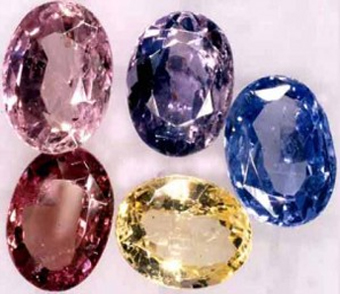
Color palette with sapphires all from Sri Lanka, worked using traditional systems. Their pleasant pastel color is natural.
Specifications
Basic chemical formula: Al2O3. Crystal system: trigonal; (twin hexagonal pyramid). Refractive index: 1760-1768. Birefringence: 0.008. Specific weight: 3.99-4.00. Hardness: 9. Dichroism: accentuated, dark orange – dark carmine. Optical spectrometer: characteristic doublet in dark red. Asterism: sometimes present, both in clear stones as in turbid ones. (Visible only with cabochon cut). Source: Burma, Thailand, Sri Lanka, Tanzania. Imitations: It is among those stones that have the highest number of imitations; but fortunately, there are many well-equipped gemological laboratories in position to dissolve any doubts. Color: red, in many hues. The most beautiful is a deep red, brilliant and at the same time velvety shade. Goodness knows why it is called “pigeon blood colour”?