No products in the cart.


And how do you write on Sapphires? It is not possible to speak of the sky and of the sea in a few pages. And how many words would it take to write on the skies and the seas of billions of years, enclosed and concentrated in these gems during the time of their geological formation, over the millennia needed to form the crystal, with the history of the planet that slowly unfolded, and that at some point triggered the process of life; next that of history, later of your own adventure, in your walk with that one stone there when it began to germinate, amidst ten thousand forces that permeated it, it had one that would take it up to you through a tortuous path, which foresaw a slow increase in the heart of the mountain only to be torn by a landslide and dragged into a stream up to a valley then abandoned.
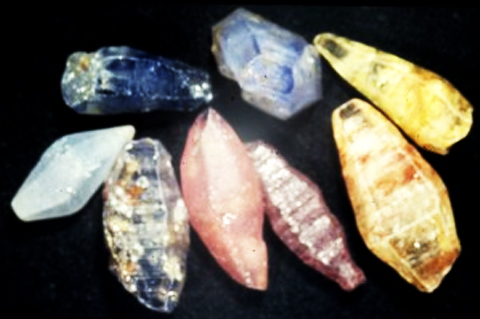
Lot of raw alluvial corundum. Notice the variety of colors and shapes.
And there you, sapphire, you’ve been waiting for someone to come and look for you, then you have been glued to a stick and cut on an abrasive disc, and then again, out and about, around the world, from one hand to the next, until when you quit lodging in pitch black sacks and safes, and now you’re secured with four thin ingots, in the open, in full light, and two eyes, bright almost as much as you are brilliant, look at you with joy and affection because, finally and conjointly your story has its fulfillment, you beautify a finger, you elate a young woman and engage in life’s grace.
Why, if this young woman is a high expression of vitality, you, your light, your brilliancy, your color, the overflowing of your blue and your velvet are a great statement of the mineral kingdom, which is the first and most immediate to the Creation; and your comeliness is its declaration. And I like to consider that when the crystal was formed, the axis of that fine double pyramid was pointed towards the North Star, because this is what we find in legends: sapphires that will be worn by the most deserving people, have been formed with their axis not generically addressed to the stars, but only toward the North star, and will be charged with the right energy to accompany you on your way, with your flow and its immobility, with you watching the gem and you yourself being watched by it. A hole dug in a rice field, a very tough job and a dream of wealth that is almost always destined to last a dream. And when you find a few valuable stones, the first processing is still done with rudimentary systems.
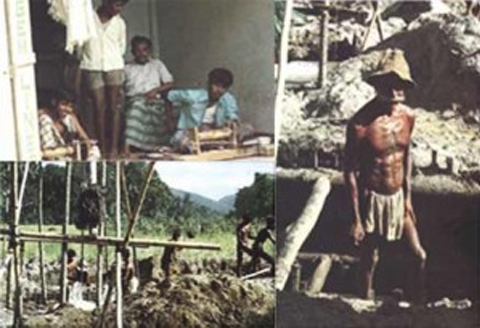
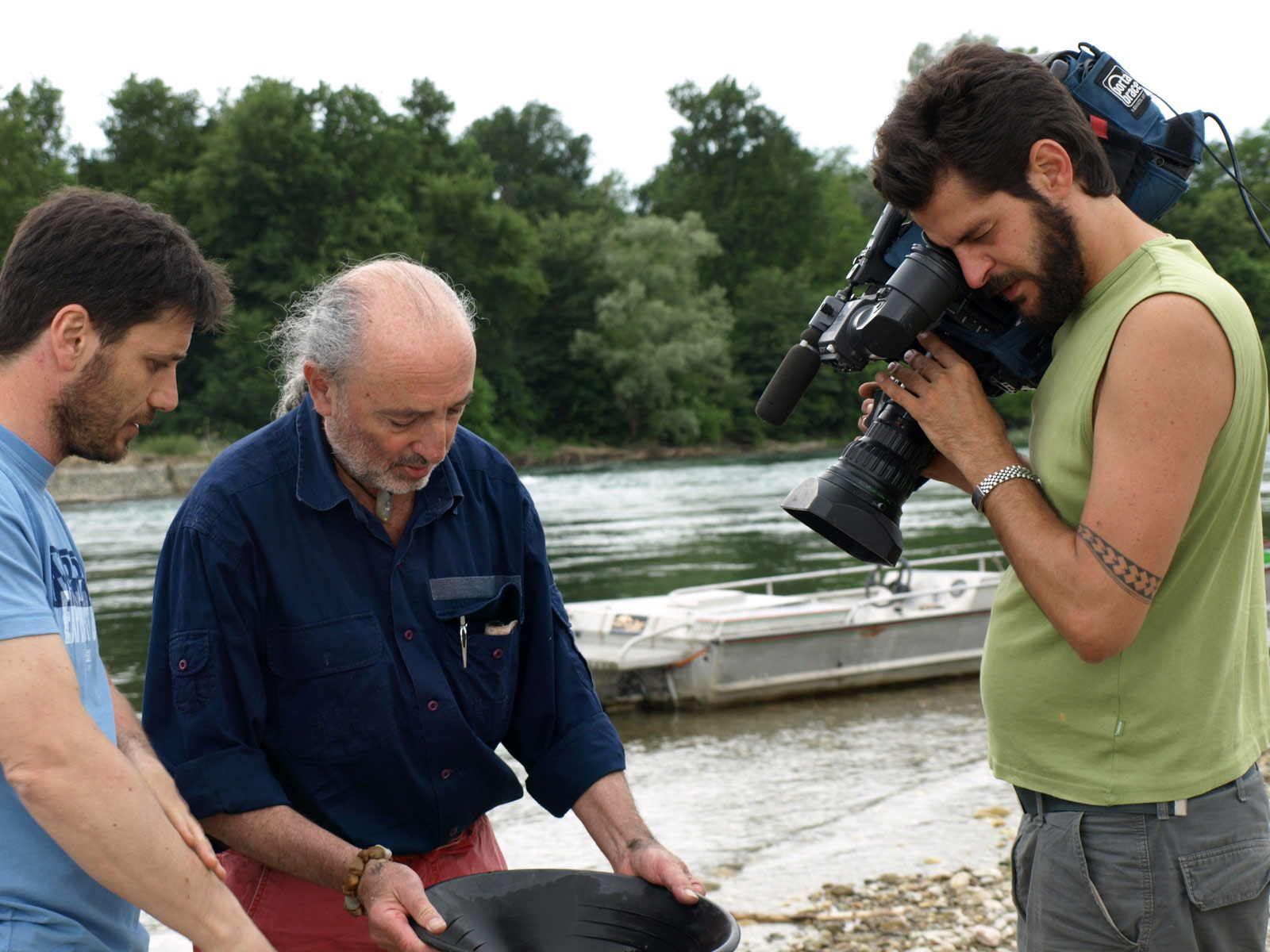
Pictures taken in Sri Lanka.

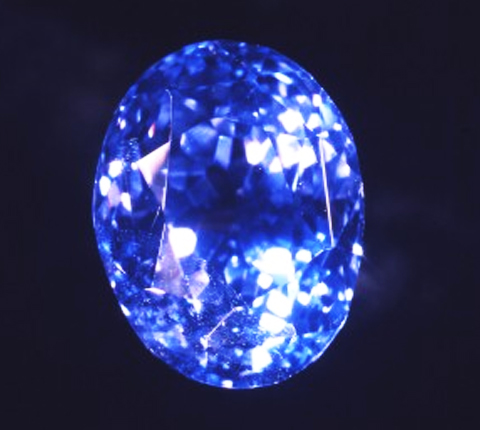
Splendid blue sapphires, completely different one from the other as regards color and semblance.
For diamond there exists a color scale, ranging from white to whiter than white, to yellowish white. Having a number of touchstones, it is possible to graduate any stone rigorously.
The same is not true for colored stones. They have tried to “qauntify” colors in many ways, giving them a number, and the results were always disappointing. Weight, cut, dimensions, refractive indices and absorption spectra are “quantitative”’ elements. Beauty, color, life, are “qualitative” factors, and for this reason do not lend themselves to be quantified, and different observers give conflicting opinions, and what pleases me is not necessarily what gives you similar emotions. In nature, overall on our globe, no two identical stones coexist. The basic colors, or primary colors, are three: red, yellow and blue. It’s interesting to note that it is the same stone (corundum), to better represent the three basic colors. Red corundum is called ruby; the yellow one, pudmaraga or yellow sapphire; the blue, sapphire. In certain sapphires the colors red and blue coexist, and the purple that results is very strange, because it is evident only in certain conditions of light: a fine blue in natural light and a mysterious purple in artificial light. Reason for color is complex. We see a stone of a certain color, either because it absorbs all colors except what the one we see, or because, after some solicitation, it emits that color. Often, the two cases are added, and also certain stones change color depending on the light that illuminates them, and the angle in which they are seen. Finally, the light entering the stone, reflected, splits; it is refracted and emerges decomposed in polychrome flashes and, if it can bounce within the stone several times, behaves as if the stone was thicker than it actually is, and the resulting color is intensified. For this, trying to classify the colors of precious stones is neither easy nor possible. Each stone has its own color, its light, its life, its personality. The blue sapphire has a surprising variety of shades, ranging from light blue to almost colorless, just as the waters of a stream; to deep gloomy blue velvet, just like the waters of a well in which the moon is reflected. Among sapphires, a quantity of blackish material is present, more reminiscent of the coal that of the crystal. A gem, to be such, must be completely natural, and it must shine. Sapphire must blossom shades of blue, not green or black ones. A brilliant gem of a cute light blue hue full of flashes of light is much more becoming than a dark stone that absorbs light and it remains bleak. (*) Upto eighty percent of our body is water, and the throbbing of our blood is the echo of the pulse of the primordial seas from which we were born. When the Creator divided the waters that are above from those that are below, separating the Skies from the Seas, He created the color Blue, and the eyes to see, and the emotions to participate in it, and emotions to enjoy it. We find blue in waters, which have boundaries, even though they are vast and flowing; and we find blue in the sky, which has no boundaries. On mainland, it will be combined with the concept of rarity, and we find it in the sapphire. Peacock Blue, Madonna’s blue mantle, cornflower blue, are the main designations of high quality blue sapphire. The term corn-flower, flower of the corn, conveys a better idea; the flower is the same, but “corn-flower” is seen immersed in the gold of the wheat, and gives a better understanding of celebration and light. Peacock blue, the blue that is found on the peacock’s neck; is also a valuable term; in Oriental symbolism, the peafowl has plenty extraordinary meanings. Mantle of the Virgin. You have to imagine a window in a cathedral, with all those beautiful colors, and the light of the sun shining through it, and Madonna’s mantle that scatters, illuminating us and so on. The question is that I have visited quite a number of cathedrals in search for this God-sent mantle and wanted to take a picture of it; and, after all, have not managed to, and the few that I discovered were all different one from another. It is still a color swatch that remains quite abstruse and unverifiable.

Sapphire with gold and precious stones inlays – platinum bracelet with a glorious central 47ct sapphire
Investing in blue. As with all precious stones, it is logical to face the issue: how much it is best to spend to have them. Besides, it is feasible and conceivable that precious stones are a good financial investment.
But the eventuality of a future gain should not be the only determinant in decision-making. The “safe haven” perspective is secondary to the pleasure of owning a beautiful, rare, unique gemstone. But back to the problem. How much to spend? You can spend a little for a fancy belonging, and a big amount for something of great value.
If you are looking for something exceptional, than there are virtually no limits; the Bible clearly explains what is the value of precious stones: (Matthew 13) 45“Again, the kingdom of heaven is like a merchant looking for fine precious stones. 46When he found one of great value, he went away and sold everything he had and bought it.” When the “qualitative” overcomes ordinary levels, the “quantitative” nullifies it since it does not matter anymore. For this logic, a certain “sacrifice” is called for when acquiring a precious stone. For this argumentation, precious stones, are, indeed, “precious”.
Specifications.
Corundum (Al2O3), crystallizes in the trigonal system, generally with a double hexagonal pyramid shape. Its hardness, 9,0 (Mohs), although much lower than that of diamond, is among the hardest materials on earth. It can express itself in red (and will be called ruby), in blue (called sapphire), and in yellow (pudmaraga or yellow sapphire). It can also be orange (padparaska or orange sapphire), violet, gray, green, brownish. The colorless variety is also called “leucosapphire”. Certain stones, worked as cabochons, show the pleasant star phenomenon: these are the star sapphires and star rubies. Specific weight: 3.99 =; Refractive index: = 1760-1768; Birefringence: 0.008 =. Origin: Sri Lanka (Ceylon), Australia, Burma, Kashmir, Kenya, Montana, Siam. The deposits are generally alluvial. Ceylon sapphires are said to be clear, Australian ones are very dark, those form Kashmir are a dream and so on and so forth. Unfortunately it is not so simple, because there is clear and dark, good and bad material in all quarries, and very often it is not at all easy to establish the origin of the gem. Warning: Sapphires and rubies are precious stones par excellence, and research of synthetic materials that are very similar have produced stones that can be misleading. Furthermore, natural corundum lends itself to be manipulated in the laboratory: its color fr eg can be changed with heat treatments, radiation and other sorts of contraptions. The most routine practice is that of transforming the “Gheuda” (milky bluish-white sapphires) in sapphires of a nice blue color, or blackish ones into sapphires of a dark blue color.