No products in the cart.


Beauteous chrysoberyl of about 7 carats

Lot of chrysoberyls: these gems’ hues vary from yellow to brown to green
One thing is sure: the feeling of jubilation upon opening a paper envelope treasuring faceted chrysoberyls is unique. And it’s no refractive index, no dispersion, non transparency problem; nothing of the sort.
It is something else, something more subtle, some luminous vibration which resonates the thin rope that ties us to the idea of celebration, of gaiety, of serene joy. Synthetic stones, which to instruments seem very similar to natural ones, do not give this jollification atmosphere; rather, they look like sterile ice crystals. It goes without saying that chrysoberyl is suitable for those who love company, merrymaking, rejoicing, and, you know, it is good practice that chrysoberyls be worn, in a bunch, not alone.

‘Cat’s eye’ chrysoberyl; about 7 carats. One of the advantages of taking pictures of precious stones in direct sunlight is that, sometime, can even portray the landscape in the background. In this cat’s eye the branches of an autumn boulevard linger.
A strange fact of this stone is that it is more known for its exceptions rather than what it is normally. The “cat’s eye” or “cymophane“, is a chrysoberyl that, cut in cabochon, presents a strip of light that passes through the stone, and the effect is just as if a sleek feline were keeping a secretive watch on you overnight. In Sri Lanka, people who know about stones, distinguish “cat’s eye” as ‘a walking stone’. It can be found anywhere, without the need of predicting its whereabouts using geological prospecting or having knowledge on the concurrent presence of other specific types of stones. Often people have found one of these gems in their own plot of land, sacked it digging it by and large, in search for others, devastating the land to crops, without finding anything. Because of this special feature of a “walking stone”, it is usual to lose the rings with cat’s eye, only to find them, even after many years.
For these reasons, it is good to keep this solitary stone alone. It is suitable for those looking for a light in the darkness, a feline sensitivity during solitary walks, a company for introspective peregrinations. Another rarity in the family of chrysoberyls is the “alexandrite”. We see a gem in a certain color because it has absorbed all colors except what we see, or because it emits that color specifically. Sometimes the balance between the two cases is weak, and it may be sufficient to change the type of lighting to have two completely different colors. This phenomenon, which is considered by many (one wonders why) to be due to a defect in the sapphire which from blue in natural light turns into purple in artificial light, whilst the change from wine red in artifical light to green in natural light is regarded as a great wonder with alexandrite. Alexandrite chrysoberyl is, objectively, less beautiful than the usual chrysoberyl, but its extreme rarity makes it a coveted gem, and it so often happens that, around the world, someone tries to sell synthetic corundum which mimics the alexandrite. There are only a few tourists, who during their visit to Egypt, did not let themselves be charmed by this stone, and one hundred and ten times out of a hundred it was a fake. Egypt has nothing to do with alexandrite, nor has the city of Alexandria nor the city of Alessandria in the Italian Lombardia region, because alexandrite owns its name to some Russian Tsar. To whom should we advise this stone, not so beautiful but so charming, never equal to itself, unsteady and unsettling? To those who are in the midst of becoming and metamorphosis, those who travel more easily over time and space, those who feel more lifes racing through their veins, those who have the impression that the present time is not so uncompromising because there are ten thousand compossible presents.
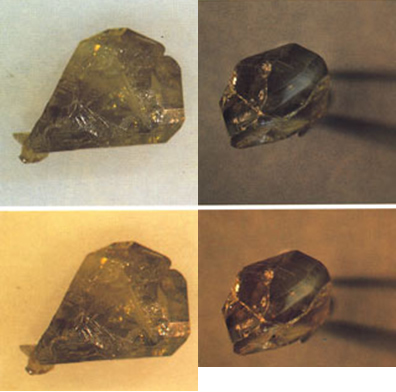
These pictures depict a single stone in different lighting types and positions: it is raw, well-formed and well-twinned. This one in particular comes from an alluvial deposit in Sri Lanka: ancient floods have not damaged it. If you add that it is an alexandrite cat’s eye chrysoberyl, we can say that this is indeed a quite inique finding. The weight is 3.39 carats.
And, since music is the branch of knowledge in arts and humanities which more than any other is expressed with mutations over time, an alexandrite, though very small, will be perfect to accompany any musician.
An alexandrite cat’s eye chrysoberyl is an island in an island; a rarity among rarities. Really it is a rare gem, of exceptional value, and truly unsettling lure. To whom should one advise these gems? And how to encourage more people to have items that are more unique than rare, and are therefore unavailable, if not at the cost of outstanding sacrifices?
Who has on an alexandrite cat’s eye is not a common person. Watching out for the music from one’s inner journey, and not getting lost despite the changing aspects of that same path, is not commonplace, but it is, if that same person lives in an aesthetic dimension permeated with great music and great magic.
It’s a stone that should be owned only by the great magicians, and it is common knowledge that if it is unwisely worn by one who does not match up with it, than he will lose it or will be lead to loose it, and the stone, on its own, will look for another story by itself, to finish, wonder why, in an eagle’s nest or by a great magician.

Alexandrite cat’s eye chrysoberyl, in natural light (small picture) and artificial light (large photo).
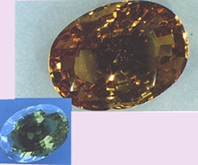
An exceptionally clear 6.99 carat alexandrite chrysoberyl. It comes from Sri Lanka. We see it in natural light (small picture) and artificial light (large photo).
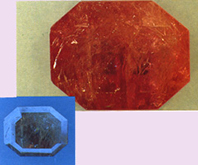
Alexandrite (4.86 ct) from Russia in natural light (small picture) and artificial light (large photo).
Specifications
Hardness: 8.5
Refractive index: 1747-1756
Chemical formula: BeO.Al2O3 (check a me sembra 04)
Crystal structure: rhombic
Specific weight: 3.71
Color: colorless (rare, sometimes found in diamond fields), to yellow, brown, brown, green. The coloration is due to traces of iron. The color change of the alessandrite is due to traces of chromium oxide. The variety “cat’s eye” is also known as “cymophane”.
Deposits: Brazil, Sri Lanka, the Urals, Burma, Madagascar, Tanzania.
NOTA BENE: There are very dangerous imitations and synthetic gems in commerce. We recommend great caution especially concerning alexandrite. The “cat’s eye” phenomenon exists with other gemstones, some of which (apatite and scapolite), can be very similar.