No products in the cart.


A quartz (rock crystal) sphere. Rutile needles, inclusions in the cloud, bubbles, light and a touch of magic: this is the crystal sphere.

Cabochon fantasy: tiger’s eye, eagle’s eye, bull’s eye, agate, landscape stone, rhodonite, palm fossil, ruby zoisite, lapislazuli, sodalite, pyrite, rock crystal, citrine, tourmaline, rutile, dendrite, ………
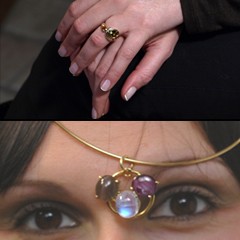
The most brilliant cabochon in nature is the drop of water, a must see when sunbeams radiate it. Stones cut as cabochons try sometimes to repeat such excitement. The cabochon cut doesn’t want to play with sunlight to make it sparkle; light must be captured by stone, to highlight just a color, or the drawing of an inclusion, or a particular game such as a star, a chatoyancy, an iridescence. The stones with this cut are less eye-catching than the faceted ones, but they have the ambition to be contemplated with calm, to be a blessing, an energy flux capacitor in particular of emotional energy. Quoting transparent stones, diamonds are never seen cut into cabochon whilst all other stones can be. Especially the quartz: all fortune-tellers are familiar with the crystal spheres and they use it for their intangibile journeys in time periods other than ordinary ones. In cabochon cuts, often inclusions within the stone are emphasized.

Photo 1 – Red amber. Until a few decades ago, one of the best ambers in the world, ‘simetite’ was being extracted from the Simeto stream bed. Today there is nothing left: the course of the river has been changed, dams have been built. This fine sample, with the color of the best simetite, is amber from Dominican Republic. Photo 2 – This impressive sample, always Dominican Republic amber, harvested two flowers thirty million years ago; flowers that never fade. Photo 3 – Colors appear to disappear to reappear; crystallized rainbows in this labradorite. Photo 4 – Pleasant cabochon, light blue sapphire.
Really, these may be so showy and obvious that the stone just operates as a support, a frame, a container of any one particular emotion. It’s the case of amber, which has crystallized the story of life and death in its fossil resin drops; it’s the case of quartz, which drew delicate landscapes and bouquets of flowers with thin dendrites of iron and manganese oxides, or that has germinated bushes of rutile needles and tormaline straws within its mass, or stones that play with light, like the opal or the starlike stones, cat’s eyes, adularescence, shimmering, iridescence, labradorescence, milky, flaming.
There is no competition between the faceted stones and those of cabochon cut; it can be said that the multifaceted spill out their sparkle, while cabochon capture attention internally. Also, the shape of the cabochon allows a side view of the stone, which is not generally possible with the faceted ones. There is much to be said on ‘side view’; when one looks at something from the frontal point of view, one has very specific quantitative information. .

The mythical dragon eats its own tail, while swallowing to expel the Cosmogonic Egg, the birth and death of all stars. A beautiful sapphire star interprets the Cosmogonic Egg, and the structure of the Dragon allows a wider viewing of the lateral vision of the gem.
When one looks out of the corner of one’s eye, that is, with the “side view”, one gets very important qualitative informations. At an equal weight, a faceted gem will be seen from a distance by its glitter, while a cabochon will be noticed for its size and to the strange emotions that arise, often, from we do not know where.
The quest for nonconformity at all costs, and modern technology resources, have yielded offbeat cuts with mortises, recesses and milling. This involves decorative objects that generally utilize semisynthetic or synthetic materials, thus are well suited for imitation jewelry.
A totally different matter are cabochons carved in haute-relief or bas-relief on hard gemstones, that reintroduce cameos and typical seal-decorations; these need little tehnology but a great deal of skill. We are talking about transparent cabochons, and not of massive stones like lapis lazuli, turquoise and agate. Such stones are especially good for necklaces, statuettes and carvings.
We have not considered pearls, shells and coral, because they are molluscs and coelenterates, which we prefer to admire alive on the seabed.
Some say that one chooses the cabochon cut for that material that would otherwise not have been clean enough if faceted. These are gross simplifications. Given a rough stone, and a cutter who knows his job, it would be best to have him interpret as he see fits it best, in order to let the gemstone express all its emotional potential, maximizing strengths and minimizing defects; concentrating color and fading nebulosity; accentuating the positive features, and reducing the inevitable flaws. Hence a faceted stone will be born, with a fancy cut, a regular cabochon or of a more bizzare form, but it will be a unique masterpiece, an opportunity for pleasure, wonder, company. A link between us, the Mineral Kingdom and the Emotional Kingdom.
And, among ten thousand vibrations of the crystal sphere, or the gem of a thousand colors, we can find the one that vibrates in tune with something within us, and that stone will be “our” gem!