No products in the cart.


Colorless stone of thousandths of colors

Diamond is the hardest natural thing on earth, and its chemical formula is: “C”. But not all carbon is diamond. When this element, so common in nature, is treated particularly gently, it forms the chemical basis of all known life: there is no life without carbon. Diamond needs uttermost temperatures and extreme pressures found in volcanic chimneys, where the choosing between the compactness of the planet and the ardor of the star is not yet well defined.
Likewise, graphite is pure carbon. One could say that this element loves to manifest itself in extreme conditions. Graphite, so black, dusty and dull. Diamond, so colorless, brilliant, hard and simple. Life, so chimerical, diversified and complex.
In this game of other extremes, a full circle forms with man and the diamond. The most highly developed life event based on carbon, man, of a precarious and fragile framework, has settled in its frame of reference, Nature, high-handedly, with the explicit intention of conforming it to his needs, domineering it, understanding it, loving it, surrendering to it, worshipping it and relishing its perfection; and scrutinize it, vitalize it, violate it, respect it to finally find himself in its endless games of opposites, of hatred and of love, challenges and regrets.
And, with a somewhat godly and sinful pleasure he finds in denaturing elements, as if defying the one who created them so, with his hallucinated wild eyes, the first genius to spin the first wheel, and finally soften the first flint to obtain a sharpened tool with which to skin an animal and make the deadly arrow tip to start the legendary “Stone Age”, and by rubbing two stones succeed in sparks, mastering fire winning the darkness, and upraise temples, cathedrals, pyramids, dolmens, highways, slums, tunnels carved into the mountains and under the sea, and pathways to the moon, and open paths in the jungle with army tanks, and ant heaps, human anthills of tens of millions of inhabitants, and radio links, war reports, commercials, and humanity living in the world of illusion, imagining itself not afraid of the roaring of saber-toothed cats anymore. Man believes he has broken up with magic and superstition, and always redresses with new clothes but old amulets, and everyone appreciates the diamond, to which they confer different meanings, because they have forgotten the simple classical “why” of this stone: the redemption of the small man on the greatest histories and on nature, all in all achieved with the inventiveness required to transform things, and with the desire to “get to know” the Light!

Industrial raw diamond powder, at high magnifications. Of a yellowish color, generally. Note the transparency, good geometry and crystalline inclusions.

Natural raw diamond. Only a small part of these crystals will be utilized for gemological purposes.

“Melè”. About five hundred of these stones are needed to obtain one gram (5 carats). And these tiny grains have been handmade in India, one by one, and each little diamond, of an average weight of 1/100 ct, has 57 facets.
And the first matter to undergo transformation was the chipped flint, which kicked off the Stone Age, the Age of Man. On earth, everything is, in some way, transformed earth; in this reorganization man took an increasingly active role, and the hardest matter to alter has become a symbol. Then, overcome the concurrent urgency, man has had time to think, and the luminous stone is also a symbol of this “bridge” from man to the Mind man.
We are talking of the diamond.
A conveyor belt passes through a darkened room. It carries well-leveled soil, under an X-ray beam. Diamond is photoluminescent when hit by X-rays, and a photoelectric cell activates a device which collects the bright grains. So in diamond mines one must never even lose the dust. All such efforts are made because diamond is, industrially, ‘something else’. How much does this industrial diamond dust cost? Wholesale price is less than two dollars a carat.
Diamond is not that uncommon. To make it more rare, four characteristics have been invented, the best combination of which declare the rarest: weight, color, clarity, cut.
But these are purely mercantile notes, which are valid only within their setting. In India, I happened to see a diamond cut in a briolette shape, of about ten carats; the cut was far from accurate, and had been drilled by hand to a third of its length. Within it, span months, perhaps years of the work of some quiet craftsman, probably at the service of a gentleman who then ended up in extreme misery, and that stone was there for me, available for a few thousand dollars, and I am still lacrymose today for not having had the sum, and recall that masterpiece with nostalgia
Someone probably will have bought it, sawn it into two pices lengthwise, and will have made a pair of stupid drop cut diamonds, with a weight of 3 to 4 carats each, having nullified the magnum opus of unique craftsmanship.
And what about synthetic diamonds? In gemology this seems to be a taboo subject. It is indeed possible to make synthetic diamonds for industrial use in the laboratory. And for gemological purposes? For the last thirty years I would say it is possible, but at prohibitive costs. In thirty years, the accretion technology of synthetic crystals, mainly driven by demands of the electronics industry, has made great strides forward. It seems strange that diamond be an exception, but this seems the case.

The vast majority of diamonds in circulation, passed from the hands of a single company: De Beer. And almost all of the world market, is in the hands of Jews. One explanation is that these people, historically accustomed to moving to different countries taking with them only a few belongings, found in the diamond a faithful companion. A considerable value in a restricted space. In addition, processing techniques were not disclosed outside their circle, and essential tools for the making were minimal. Currently, the veil of mystery regarding its manufacturing has dissolved a little, which is increasingly entrusted to industrial machines, and new markets are being developed in a regime no longer completely monopolistic.
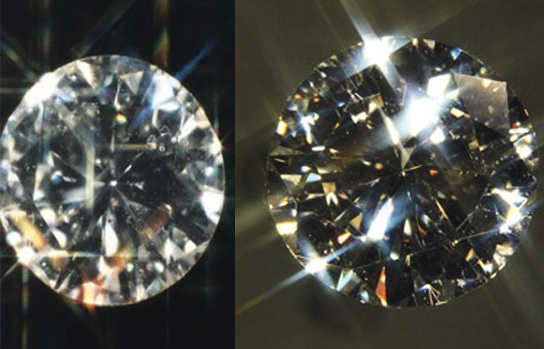
Wholesale diamond prices are rather rigorous. There is a reference price list for wholesalers, and the skill is in finding stones whose quotation is below this price list. But cost is not the only factor to examine. Before the rate, you have to consider: – The prestige of the certificate; – The presence or absence of improvement processes regarding color or internal characteristics. – The wholesalers’ list refers to the weight, the internal clarity, the color. The quality of the cut and the fluorescence, which is not indicated between the variables, may justify variations in the listing by more than 10%; – The origin of the stone must be lawful.
Specifications:
SPECIES: diamond
VARIETY: diamond
CRYSTAL SYSTEM: cubic
COLOUR: colorless to yellow-brown. The green, brown and yellow colors can be induced by atomic irradiation.
CHEMICAL COMPOSITION: “C” (pure carbon)
HARDNESS: = 10 =. It’s the hardest known natural material.
SPECIFIC GRAVITY: = 3:52 =
REFRACTIVE INDEX: = 2,418 = CUT: generally round, so that “BRILLIANT” means “natural diamond, brilliant cut.” Of course, only one particular cut is called “brilliant cut”.
ORIGIN: South Africa, Siberia, Borneo, India, Brazil, Australia.
NOTES: It’s the stone that boasts the largest number of imitations. Currently the “cubic zirconia” is the most dangerous, and is sometimes mixed together in lots of natural stones. There are simple diagnostic devices that can be used, and we advise all jewelers use it. A fun identification, is to rub the stone against a corundum. The softer stone will be marked … but destructive analysis techniques are not good; even if the temptation to adopt them against false stones remains strong. The “Moissanite” is deceptive imitation, because of a hardness of more than “9”, and of a very high refractive index. It is distinguished under the microscope because it has numerous needle-shaped crystals, and a visible birefringence on the belt. With small stones, everything is difficult for non-experts.
REFERENCES: There is a wide choice of gemological, historical, apologetic texts. An interesting book under the journalistic aspect, is “DIAMOND-Edward Jay Epstein” Even in our work “PIETRE NON ORDINARIE”, a special charter is dedicated to the diamond.
CERTIFICATION: All objects of great value should be accompanied by certificates executed by serious professionals, and precious stones are no exception. A good certificate can be both open, and sealed. If it is an “open” certificate, it must give a full set of gem identification data, so that it is possible to recognize it from other similar ones. If it is a “sealed” certificate, it is very often considered valid until when it is opened.
CLASSIFICATION: Diamonds are classified by weight, color, clarity, cut, fluorescence. Currently there is a tendency to standardize the evaluation criteria, although there are still hybrid terminologies, especially for the color.
OTHER ADULTERATION: As all stones, even ‘ugly’ diamonds are the subject of attention in order to invent tricks with which to “improve” them. The certificates must include any such processes, or their absence.