No products in the cart.


Emerald from “Muzo” (Colombia) of more than 30 ct, of good quality. In all quality stones, color is aggressive, but does not affect the brilliance of the gem.
When, in the East, I sought for stories of stones, I found legends and fairy tales crammed with colors, perfumes and adventures in which princesses, gods, magicians and intrigues overlapped with religious symbols and edifying teachings. It is in these atmospheres that my love for stones has developed. When, in Columbia, I sought for stories on emeralds, I only found crime tales. A wise old man, who had strangely managed to grow old living in the Muzo district, explained to me that, in the search for emeralds, the bones of the “Ancient Mother” were weakened, and that was very bad. Because emerald is a living thing, even if it seems lifeless. And the Ancient Mother would have recreated the balance giving another green gem’s gift: the leaf, which seems alive, but donates death. Colombia. Land of emeralds, drugs, beautiful and nice and friendly people and violence beyond belief.

Emerald has always been hunted where it was more readily available: in the incredible pre-Columbian temples, by the conquistadors who thought of melting gold objects that they had raided and that, by hammering, they verified the hardness of the emeralds they found in the same objects. Or, directly from the bag of emerald seekers, for whom the time of the discovery of the stone corresponds to the beginning of fear. Even traders do not have an easy life; despite living in incredibly protected forts, robberies and killings are commonplace. And, at the origin, emeralds were searched where they were born, in primary deposits, where, by means of dynamites et similia, entire mountains were ruined, all of this to obtain a handful of hexagonal green pebbles.
Green yes, but ‘emerald green’. The green color comes from the mixture of blue and yellow. Symbolically, blue water and sky with the yellow sun, gives birth to the green of the earth. And green is indeed the characteristic color of the (land) surface of our planet. Green is then the color of the transformation of earth into life, and it would seem that if this color, rather than in the plant kingdom, should form in the mineral kingdom, in this case in emerald, the stone would be charged with a very strong energy, as it were the energy of life that cannot expressed itself because it is compressed into a stone, and then it will surely find other ways, emotional, magical, subtle, to express itself and to channel its skills. And, very often, these are violent ways.
Transforming earth into life, is also a sign of the supposed power of life on earth. And, for this reason, emerald has always been attributed with a “power-worth” superior to that of other gemstones. You can find it on scepters, famous daggers, crowns, décolleté of the most ambitious actresses.

Natural emerald stones from Colombia’s Muzo caves – ct 1,92 gemstone of extraordinary brilliancy, transparency, color (bluish green), velvety and matchless clarity. Gemstone of exceptional beauty – ct 2,27 the very intense coloring actually compromises its luminosity a little, but it sure does not undermine its translucence nor its sumptuousness.
“A diamond can be craved for prestige; a ruby for magic; a sapphire for love; but an emerald is always desired for greed. “ This bizarre way of seeing stones taught to me by a trader in Jaipur (India). The fact is that as he showed me his stones, he himself transfigured, becoming a serious Western-style professional when he showed me diamonds; a romantic dreamer with sapphires; a jealous magician with rubies. And when he showed me the emeralds, which were absolutely gorgeous, of a light, a color of worth that were all unapproachable, his eyes glowed green, proud to own things of a higher beauty, and he was sure there would never be enough money to buy. Color. As we all know, there are many ways to change the original color of the stones. The emerald, contrary to many precious stones, does not alter its color with radiation or heat treatments.
However, it is often impregnated with oil, and this is because the microfracture within it behave like ground glass, and become more transparent if greasy. This is not a big problem, because the stone absorbs the oil by capillarity, and just as easily it can be washed. Furthermore, these simple treatments have been practiced since ancient times, and in any case do not alter the physico-chemical characteristics of the stone or energy (which is the case with radiation and pressure heat treatments). So no big deal if the stone has been treated with a colorless oil; to censor are the treatments with green oil, which are not limited to attenuate a fault, but they want to add an absent value to the stone. Today, you can find stones impregnated with low melting point glass or with epoxy resins. These treatments must be declared in the documents accompanying the gem.

<em>Emerald ct 3,10 from Colombia’s Muzo caves of exceptional excellence, clearness, color (bluish green), velvety and clarity.</em>
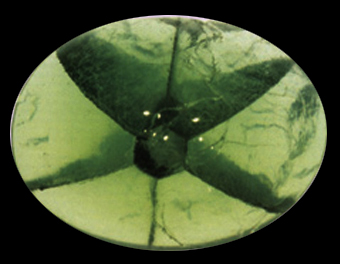
Bizzarre black inclusions, form a typical figure named “trapiche”. These rare gemological curiosities come only from the Muzo district.
Good quality emeralds are very rare, and therefore are very costly. This urged industrial research to produce synthetic stones extremely similar to natural. Fortunately, there are also many gemological laboratories that can dissolve, any doubt, very simply. So, if you have doubts about a stone, DO NOT go to disturb a goldsmith or jeweler who, however rich experience, is rarely a professional gemologist. Confident, talk with a qualified lab for analysis; with little money you will resolve your doubts, in this way you’ll also have the opportunity to tattle with a passionate of stones. And the origin? Well, yes, Colombia. But there are emeralds also from Brazil, Zimbabwe, Russia, India, Zambia, Austria, and there are many other smaller deposits in many other parts of the globe. Moreover, there are deposits that give clearer material than the Colombian; others that give more colorful material, others more brilliant. Finally, all agree that it is difficult to find a more dangerous place than Colombia. Nonetheless, those who say emerald say Colombia, and this is one of the many bizzarre facts that accompany precious stones. According to the “Traditional theory of colours“, green is, in the chromatic scale, opposed to red. Then, a color balance with the green, is obtained by uniting it to red or, alternatively, to purple and orange together. A union with with blue and yellow would be unbalanced. (Union with colorless, white, gray, black and brown, is neutral, since these are neutral colors). According to these theories, it is good that the composition is balanced, otherwise the stones’ internal forces would seek this balance elsewhere, with effects that would escape our control. We are careful to and respectful of all these theories, and we have repeatedly expressed our point of view on the subject. Each type of “knowledge” is a step forward at the time of its acquisition, and a further step forward in the moment of its abandonment. We are therefore opposed to any too simplistic official stance on the matter (like: “all fantasies“), and too fideistic attitudes make us smile (like some unbearable calculations of certain astrologers). We are convinced that “Intuition” is a wonderful gift that man has been neglecting, and that a good way to train him would be the dialogue with precious stones.
You know, stone merchants are weird people, and you have to trust to half of the half of the things they say. Furthermore, in symbolism, when one thing is true, there is much truth also in its opposite. So if a stone can, in certain circumstances, generate violent feelings, it’s all a matter of approach. That same stone, if approached in the right way, can generate the most sweet and ineffable feelings.
On the other hand, if green is the color of life on our earth, everyone knows that life would not be life without passion, ambition, desire, violence, love, hatred, dreams, a pinch of madness, and all possible feelings, uncensored and without prejudices.

Heart-cut emerald of uncommon gleam, clearness, color (bluish green) and velvet, ct 5,21 from Clombia’s Muzo caves. The heart-cut emphatizes this gem’s brilliancy and personality.
When Nerone watched his time through his emerald eyeglass, he saw things other than those that the impostor who sold him that false emerald (although the issue is still open: some say that it was a good emerald; some say it was a fake; some say that Nerone had no eyeglasses at all). However, things were even more different from those that the craftsman saw -the one who had ground the stone, good or false that is were. Finally, some advice. If you want an emerald, rather than the color or cleanliness, mind the brilliance. This advice obviously applies to all stones that to be “gems“, must, first of all, sparkle. But, concerning the emerald, too often we come across absolutely murky stones, which look more like mint candy than the realization of an old dream. And, of course, we suggest a lot, but a lot of attention.
The evaluation of an emerald, like the majority of colored precious stones, must take into account many factors, in addition to the overall beauty of the gem. – The presence or absence of improvement processes of the color or of the internal characteristics. – It is not true that the most colored stones are worth more than the light ones. A gem must first shine, and if the stone is too dark or murky, will not shine. – Almost all emeralds have suffered oil impregnation. This fact should not alarm. Many certificates bear the words “impregnated emerald”. If nothing else is specified, this is no demerit for the stone, but for the analysis lab. One thing is to say “emerald impregnated with colorless oil”, another, is to say “emerald impregnated with colored substances”, and another thing still is to say “emerald impregnated with resins or glass”. The impregnation with colorless oils is ancient practice, and serves to mitigate the internal cracks, formed together with the stone, the latter which has grown near a volcano, and was extracted with dynamite.
– Origin. Almost no certificate indicates the origin of the gemstones. The few labs that dare mark it, use phrases like “on our opinion the provenance is: …”. This is because it is not always possible to state with certainty the origin of a gem. Colombia is the most renowned, but great stones may be found in Brazil, Africa, India, Europe, practically all over the world.
– The origin of the stone must be lawful. In addition to strive to offer the best prices, we put all our efforts to ensure our products from all viewpoints. So do confidently visit our display. We have a large assortment of stones. Although not exposed in the windows of this website, you can contact us directly, or better, come to visit us in person. Regarding the above “Traditional Theory of Colors,” we will soon publish an article on it. A first approach is to be found in our book “Pietre non Ordinarie”, in the chapter ” Colors to discover.”
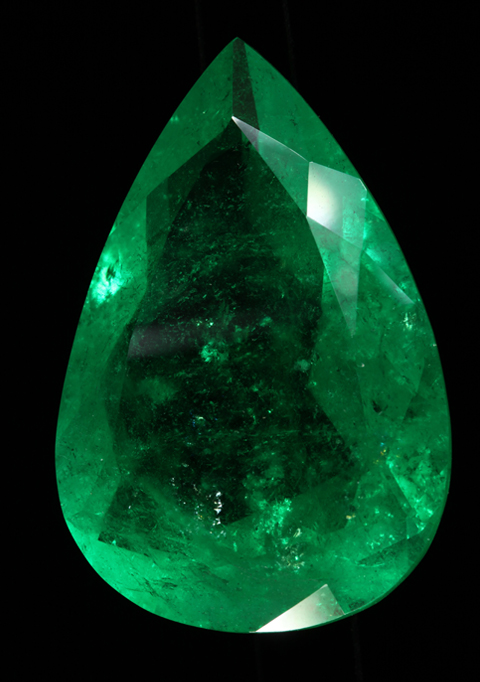
A drop of exceptional emerald of over 100 carats from Muzo.
Specifications.
Species: Beryllium.
Variety: Emerald.
Colour: Green .
Composition: 3BeO.Al2O3.6SiO2.
Hardness: 7.50
Specific weight: 2.71.
Crystal system: dimeric and hexagonal.
Refractive index: 1,579 = 1,585.
Birefringence: 0.006.
Notes: The most famous production areas are Colombia, Brazil, Zimbabwe, Zambia. Each recess has a slightly different characteristic from the other, both as index of refraction than as color. Given the great value of the emeralds, we recommend great caution, because there are very deceptive synthetic stones. If, within the stone, small white signs should appear, they can be often mitigated by immersing the stone in warm oil. Since this is a rather tender and fragile stone, we recommend “awareness” in its use.