No products in the cart.


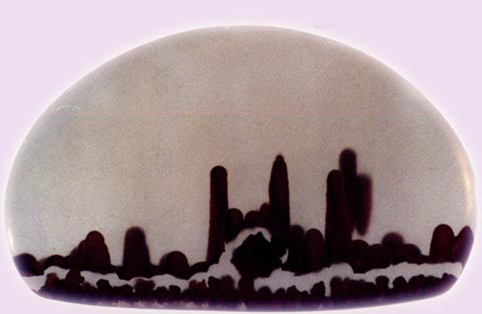
Transparent agate with well-localized brown spots. Agate belongs to the microcrystalline family of quartz, generally it is opaque with translucent areas of different colors. Despite being a common stone it is rare to find samples of such cleanness and such visionary designs. In certain fairy tales there is an explorer who finally reaches the enchanted city, city which can be uncovered searching among the stones.
The emotions related to precious stones are generally related to light and color. Then there are the “semi-precious stones“. These are hideous commercial terms which only create confusion; we do not use them. We believe that every stone has its own inherent nobleness. Certain stones expressly excite human sensitivity and, for this reason, are the subject of research and commerce. Among these, some have a name known to all, such as diamond, sapphire, ruby and emerald; others, like ekanite, zoisite, kornerupine, are known only to specialists. Many stones create astonishment and emotion due to their color, the reflections, the sparkle; others due to their shape, the inclusions, the signs, the color zoning that cross them. For others it is unclear whether they truly are minerals because they resemble vegetables and certain of them have been, in past ages, animals and plants, and withhold the imprint of life that once made them shudder. We will see some landscapes in this photographic exhibition.

It is uncertain whether what we see on the horizon are sails of sailing boats or mountain peaks, but the waves of this sea are a dream. Even these fairytale landscapes are offered by agates
They are no skilled painter drawings, nor dreamt images by other artists. They are stones, processed and polished to highlight those particular dendrites, color effects, shaded moldings that invite us to a journey of landscapes that are yes, part of our planet, but in sizes a little different from the ordinary.
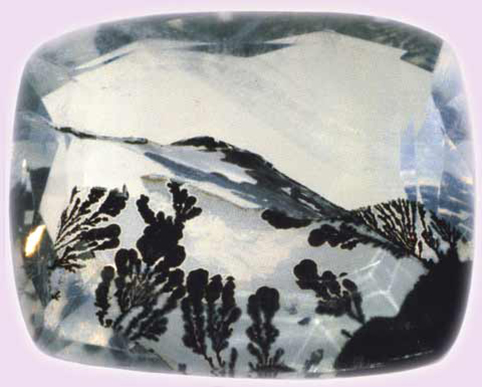
Dendritic quartz. Mountain landscape painted by a Chinese painter of the fifth millennium.
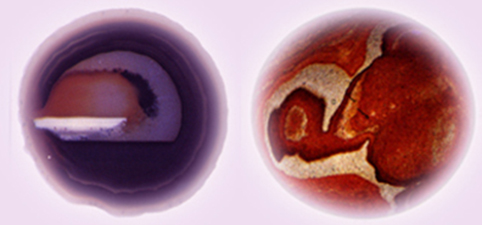
First picture: the geode section of an agate. In the sugar-white part are visible forms of a thousand tiny quartz crystals. This masterpiece of nature could be called “Waves of another sea”. It would be appropriate also because it was the water, through a thousand years of intense activity, that deposited alumina oxides and other elements to finally propose these images. Second picture: Oregon Jasper sphere. And we do not know whether there isn’t a planet with these looks.
Perhaps these are no precious stones; their cost is accessible to all budgets. Again, they usually do not come from far away countries: on a Sunday stroll you can find some stones, which, processed, could be included in this review. Almost always we happen tod eal with the quartz or the sandstone families; among the most common on earth’s crust.
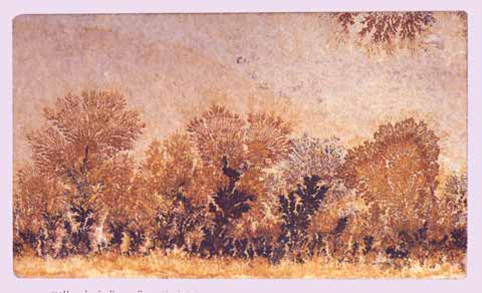
Sandstone with dendrites of iron oxide (brown) and manganese oxide (black). This autumn landscape may have been photographed in the “baragge” of Novara, or on the hills of Sila (Calabria, southern Italy). In contrast, water has infiltrated into tiny cracks in the sandstone, where it deposited traces of iron and manganese oxide, and has designed this beautiful landscape within the rock. These rocks are common in Tuscany.
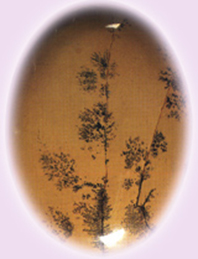
Moss agate. This is obviously not moss, but concerns manganese dendrites. This time we can imagine that the painter is Flemish.
A popular saying reads that the most beautiful walks are those made in our own backyards. Even for the stones: the most appealing emotion we can given to us by stones found on the river bed.
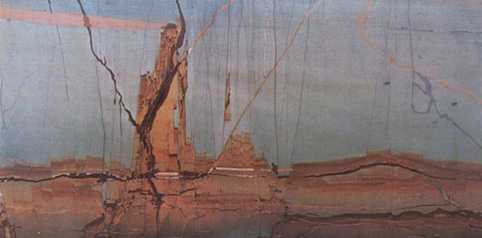
Pietra Paesina (Landiscape Stone)(Tuscany). What better name for this stone? It’s really hard to think that is not a miniature with tiny brushes performed by a talented painter. Here too it is a sandstone cross cut into slices and polished. Anyone can find them on Tuscan hills.
Geologists passionate about their work, spend much time under the microscope and find delight with the forms of certain inclusions too small to be seen with the naked eye. These stones stand out for their expressiveness without the need for other tools other than our eyes and a state of mind willing to let go a little to better participate in the magic light of these landscapes that are not places in the outer space, but unspoiled landscapes of the soul; spiritual horizons that want to express themselves in everyone, that want to expand themselves, illuminate themselves and to embrace feelings, art, poetry, and which, in Nature, find stimulus, inspiration, a way of expression.
We shall not comment the images; we leave them to subjective interpretation. We limit ourselves to a few, scant technical notes. If then, someone will still call “semi-precious stones” such masterpieces, then, well, we say: “patience!”.
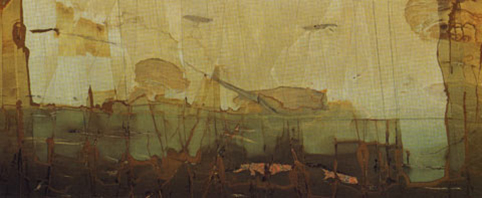
Pietra paesina (Landscape Stone)(Tuscany). Sandstone in which different sedimentations have given rise to different coloration. When you reach an enchanted island, the first thing you encounter are the hectic activities of the port.
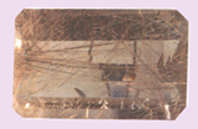
Rutile quartz. In this city of an unlikely future, the question is “how to find the needle in the haystack?”
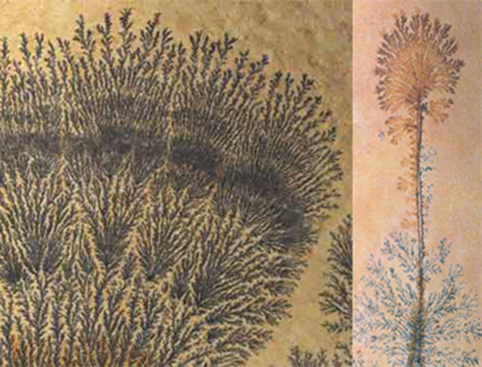
First picture: dendrites of manganese oxide on sandstone. This figure may be a bush or the feathers of an elusive bird, or any other conceivable arabesque fantasy. Second picture: dendrites of oxides of iron and manganese on sandstone. It may seem a painting pertaining to the school of Van Gogh.