No products in the cart.


Interview with Paolo Severi, owner of the master craftsman workshop ” Ori e Gemme” in Pavia.

– – Gemologist, gemstone cutter, jeweler, writer, promulgator and photographer of gemology, sculptor, gold miner seeking gold …How would you describe yourself?
– There are two ways of behaving: the fragmented specialization and the holistic view. If I decide to devote myself to stones, it seems logical that I should know them, study them, be on them, thrive on them, live them in all their perspectives.
– There is talk about the crisis in the goldsmithing industry, and people say that it is all because of eastern competition, offering goods at prices lower than ours. Is this all true?
-This is all wrong: who sows the wind will reap the whirlwind. Gold and jewelry companies, or rather, the goldsmith industry, spends far more on advertising than on research and innovation. They do not spend anything on information hence consumers often confuse the advertising with information, and is prone to identify the quality product with designer labels. Because, often, these ‘big designer names’ are synonymous of ‘high price because much of the cost is spent on advertising’: it is obvious that a lower price for a similar product would be enough to disrupt such a system. Inasmuch as many goldsmith industries went to teach the East how to make Italian jewelry.
– So, if I understand correctly, in your shop we cannot find designer lables…
– On the contrary! We treat the best brands in the world, which are those of our customers for the history and the bespoke making of the jewel, and our, competence and professionalism. Together, we create unique items, backed by true stories, related to the person, to the territory, to life. Of course, there are items related a hundred percent to personal stories and objects that tell stories related to the territory, to our culture, to certain atmospheres …
– Would you like to explore the idea of “object with a background history”, or jewel “linked to the territory”? (Paolo Severi opens one of his drawers, inside are stones with a whole in them to have cord or strap pass through them; and, always inside the drawer, is a carved niche protected by a lens. (And within lies yellow dust.)
– These are stones from out Ticino river; inside, there is a hint of pure gold, collected in the sand of our Ticino. The “strength” of this pendant is instinctive, and the link with the territory is all too evident. The “story” you can tell, is up the alchemy of the Philosopher’s Stone.

– How come?
– Don’t take me too seriously, but follow me anyway. In jewelry, the metal is the ductile part, plastic, which takes on the shape you want it to, enclosing the stone and tellina its story. The metal is the “female” soul of the object. The stone is hard, unalterable, it is linked to light and time: it is the “male” soul of the jewel. It would be enough for goldsmith schools to fully develop this simple concept, and there would be no more worries concerning Eastern competition. But back to our Ticino rock, with its goldcollected from its sands. The stone has been worked plastically to enclose within it the collected gold in its stone stage. There has been a complete reversal of symbols. If you want to use difficult words, we can speak of “the semasiological reversal in of meaning of symbols”, which, as you know, is the basis of every alchemical process.
– You talk to us seriously and you also tease us gently. We do not fall for your trap, and change direction. Can you explain the history of gold that you collect in the Ticino in a little more depth for us please?
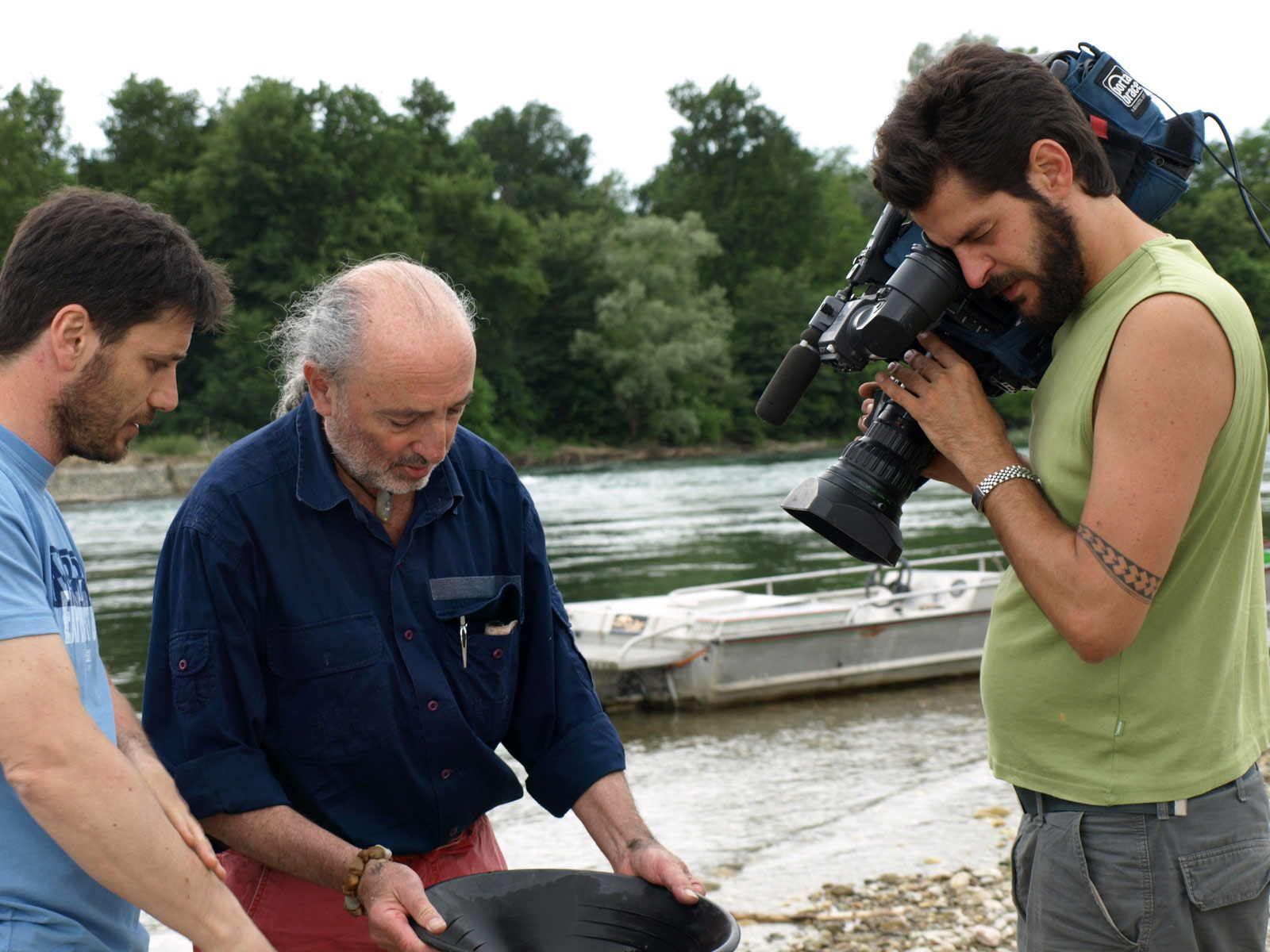
– In Roman times, here in Pavia, a few hundred slaves worked to collect gold from the river sands. Until the early ‘900, the youth of the upper valley of Ticino, gathered there – the gold to forge their wedding rings. I’m trying to revive those traditions. I love the river, and the river reciprocates my love by giving me some gold dust grams. If I take a handful of stones from the river and a few pinches of gold dust; with me I carry, and spread, the love for this beautiful river, which deserves much more care and dedication.
– But, this gold, where does it come from, how much of it is there anyway and how do you pick it up?
– The gold that can be found along alpine rivers is enclosed in tiny flakes, inside the quartzite blocks falling from the mountains. Rollino and rolling, these rocks become rounded stones. During this process, gold flakes come off and proceed on their own. Because gold has a much greater specific weight than that of the rock where it came from, while the stone will roll for thousand meters, the grain of gold will travel only a few meters. Then comes the raging river, with eddies, whirlpools, sliding banks, uprooted trees and so on. After which it falls back in its bed. What looked like a chaotic mess, has harmoniously redesigned the geography of the banks and islands. There are piles of trees over there… you mean it is on that side that all the lighter substances have now been clumped? Hence, somewhere else heavier materials have been concentrated, therefore, paying attention to where there are large stones, black powder, green stones, pieces of iron … maybe there you can focus on any gold. At this point, you only need to know how to collect. It is not difficult to collect gold from the sand, not after someone has explained to you the “where” and the “how”. Since, by law, you can’t use industrial equipment or polluting vehicles, the research must be lived as a sport. This has the great advantage of letting you in intimate communication with the most beautiful river there is. And, in the evening, you may also take home a bit of magic yellow powder.
– So if I insisted in asking “how many grams you can find in one day,” you would continue beat about the bush without answering …
– If one likes to ride horseback, I do not think they do so in order to save money on gasoline.
– After this explanation, your stone and gold pendant, winks in a special way. Have you crafted other equally emotional objects?
– Apart from my books, which treat take care of stones starting from “emotions”, all my jewels have a compelling background history to them. Among the jewelry made of native gold, there are wedding rings and the mono earrings in 24-carat river gold, rings and pendants with meteorite pieces, native gold and precious stones …
– Meteorites?
– Metallic meteorites are where the only native iron is found in nature; and with native gold form an explosive mixture of rare beauty.
– In your book you discuss these issues?
– And you still have not read them…

– Your stones, your jewels, are different from what we see in general, and very different one from another. What links them?
– Stones and jewels are an important step in the search for “beauty” in little things. If one takes this path, (s)he will become more beautiful, because her/his thoughts will be cleaner. A jeweler who lives this profession in this spirit, will have a profound ecological awareness. In my place we are proud we do not sell pearls, coral, ivory, or other objects with background stories of violence and/or ecological crises. It is also why we don’t like to treat goods crafted where, just to be able to sell goods at the lowest prices, unconcerned people take advantage and ‘use’ children as slaves. In addition, since there is nothing beautiful in lies and counterfeiting, our stones are absolutely genuine, and we also strive to ensure color authenticity. I do not wish to do any ‘gemological terrorism’, but, for example, a lot of amber on the market is plastic, or fused and reconstructed amber. The “improvement” treatments of virtually all stones are almost never declared and, often, it’s really hard to safeguard. Difficult, but not impossible.
– We know the passion that you put in the re-opening of the Church of San Marino. Is it devotion, or your wish is to work more with the church next door to y shop, open to the public?
– Finally, a politely provocative question! The trade in Pavia is punished by the lack of services, the abundance of prohibitions, and by a thousand unfulfilled promises. Moreover, it does nothing to encourage people to take paths that are not the usual, while “real” Pavia pulsates in its narrow streets and alleys, full of history, beautiful architecture, handicraft shops that focus on professionalism instead on brand names. There seems to be a plan to invite those who want to work, to go and do it somewhere else. In this perspective, the keeping closed of monuments such as the Church of San Marino, seems to be part of a perverse logic aimed at encouraging the malls of the suburbs, and to put to wer out this beautiful city. San Marino is the protector of those who, like me, work stones. If I get busy to rekindle his devotion, who knows..perhaps he returns me the favor!
– One of your dreams?
– A school where goldsmith jewelry and gemology linked to the territory is taught, (and is taught well). Each area has different things to tell, but the key is unique. We could awaken the Lombard art, little known, but of unexpected beauty, linked both to the past and the future. Its revision, could yield Nobel Prize resuts.
– Your optimistic, enthusiast, innovative, ecologically praiseworthy overview deserves all the best.
– We hope the inauguration of your goldsmith school will be soon, maybe in the Church of San Marino, while, as regards the search for gold, in springtime we can make a practical report. We remember the books “Pietre non Ordinarie”, “Pietre che Curano; Pietre e Zodiaco; Pietre e Arte”, “Le Parole delle Pietre”, “Perché le Pietre Preziose?”, Are published by the Ori e Gemme publishing house, that you can hardly find in bookstores. The Internet address (where you can buy at discounted prices): www.oriegemme.it . The workshop is: “Ori e Gemme” Paolo and Francesca Severi, Via Siro Comi 25- 27100 Pavia. Tel: 0382 302103