No products in the cart.


This red tourmaline (rubellite), has been worked with the purpose of making it shine as much as possible, and it certainly looks as if they have managed in their intent.


It seems that Merlin’s magic wand (and that of many others among the most important magicians), was a tourmaline crystal, elongated, transparent and of various colors. Modern magic that make piezo lighters twinkle, uses tourmaline crystals. It is a mineral that plays with light, colors, electricity, geometry; it sure is a bundle of mischief! There are crystals that are white in the middle, red on one side, and green on the other side (polychrome “watermelon” tourmaline); there are others that are blue on one side, fading into a green shade to finally become red, with some colorless bits; others are completely black.
If compressed, tourmaline produces electricity; when rubbed, due electrostatic reasons, it attracts or repels certain powders. Piezoelectricity and pyroelectricity are the names givent to the main electrical phenomena; policromism, pleochroism, dichroism, sometimes chatoyancy, are the names of the main optical phenomena for this stone. But, the undeniable charm of this gem, is its congeniality! A tourmaline, even a very important one, even the most expensive one, will never have the severe looks of some bigger name gems. Perhaps it is for this reason that it is the most used by stone-cutters who want to try their hand at fancier cuts, outside traditional patterns.

Lotto di cristalli policromi di tormalina.

Important tourmaline collection, with special cut

Below: Bicolor tourmaline. The liquid appearance of the fusion of two colors, is particularly eye-catching.
Green, blue, pink, red, yellow, colorless, black, brown. And all these colors can be present in pairs, even in the same stone. And it’s always creamy, velvety, bright, eye-catching colors. And they have a unique feature: they seldom resemble the color of other stones. If the red of some garnets and spinels may resemble the red of certain rubies; the rubellite (pink and red torumaline), has a color all of its own. The same applies to the green and the blue.
“Turamali”. Sri Lanka, the island country so redundant with gems, gave the original name to the tourmaline. Among the island’s gemmiferous gravels, only the brown variety (dravite) can be found, together with many other stones (zircons, chrysoberyls, rhodolites). Taken as a whole, these are known as “Tourmalins”. In any case, the difficulty of giving an appropriate name to each stone, remains. Acroite, indicolite, rubellite, dravite, schorl, are the names of some varieties of tourmaline. Their constituting chemical formula is complex, and to consider various metals’ isomorphic mixtures of aluminosilicates, borosilicates and fluorosilicates would mean anything and everything. More so, many elements can be exchanged (substituted) with others, making a difference not only in the stones’ apperance and color, but also in their chemical formula.
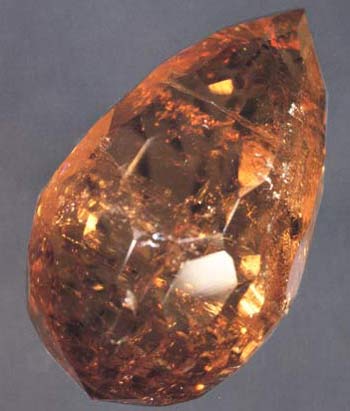
Brown tourmaline (Dravite), briolette-cut. Even the inclusions perform to give movement and charm

Green tourmaline “S”-wrought. A lovely name has been given to this delicate cut: “Silvia”.

Very bright clear green tourmaline
As a mineral, it is quite common. It is found in granites, gneiss and mica schist. The variety of gemological interest are, of course, rare, and are generally found in pegmatite druses and geodes. In Italy interesting specimens are located on the Island of Elba, and some beautiful dravite crystals in Val d’Ossola. Brazil, Russia, Madagascar, United States, South-West Africa, Sri Lanka, Burma, Kashmir, India, China, Australia, Pakistan, Afghanistan, are countries producers of tourmaline; but such a long list means that this mineral can be found quite anywhere. But each single floor has its unique characteristics.
Although it is a rare stone, it can be found all over the world, and wherever it is found, it is embedded in the socio-cultural and magical-traditional environment with much similar characteristics. Those beautiful elongated crystals, of blending and iridescent colors that, if heated or rubbed, create strange electrical phenomena; on the one hand attracting and on the other repelling certain powders, have always been treated with the respect that is due to all magic things. And it seems to be good magic. Yoga devotees, call “prana” the vital quid which permeates everything, and which tragically disappears with pollution and foul air.
It seems that negative ions promote the reconstitution of the “prana”, and it seems that keeping a tourmaline, amber, quartz and other crystal close to oneself strongly promotes the “electric” formation of negative ions. Often science discovers values that conventional wisdom had known for centuries; this is very nice, but it would be much better not to lose those values in the first place. This stone is strongly dichroic; meaning that it has a different color depending on the angle from which it is observed. So the cutter must examine the crystal well, in order to present the most interesting coloration on the centerpiece. This is true for all precious stones, but for tourmaline in particular.

Special rhombic-shape cuts, on bicolored and on blue-green tourmaline

Fanciful “pencil-cut” of a beautiful dark green tourmaline

Centrale di girocollo con tormalina verde e brillanti. Le tormaline si prestano ad essere interpretate con tagli molto allungati.

Central part of a crew-neck with green tourmaline and diamonds. Tourmalines are suitable to be interpreted with very elongated cuts.
A separate chapter should be granted to the “Cat’s Eye Tourmaline”. The versatility of this gemstone could not give up this optical phenomenon; not only; its attitude to tease magicians and psychics, certainly could not help but “play” with light, as the best “Cat’s Eye” do. Whom to recommend the tourmaline? We oppose simplistic recipes like “those born under that sign, etc.”.
Tourmaline can get charged with positive and negative electricity on opposite sides of the same crystal, and always in that same crystal can acquire more colors. It’s the stone for those who are open to the most diverse circumstances, while remaining true to themselves. It’s the stone for those who love the colors of life, but without ostentation and presumptions. It’s the stone of those who want to express their personality with joy, their participation in life, and they do not give up that bit of magic that exists in every change. It’s a stone that is to be worn alone, or with another tourmaline; it can be accompanied by at most a few diamonds, but always with rather fanciful frames.
Specifications
Crystallization: rhombohedral system.
Chemical formula: H9Al3 (B.OH) 2Si4O19 (+ presence of F). “H” easily vicarious with Na, Li, K, Mg”, Ca”, Fe”, Mn’’, Al’’’, Fe’’’, Cr’’’, Ti’’’).
Hardness: 7 to 7.5.
Specific weight: from 2.98 to 3.30.
Refractive index: from 1.635 to 1.668 to 1.618 to 1.640.
Birefringence: from -0.017 to -0.046.
Deposits: As a mineral, it is quite common all over the world. The gemological varieties of interest are obviously rarer. Brazil, Madagascar, India, Pakistan, Afghanistan, Africa, Russia, are all producers of excellent tourmaline.
Imitations: There is no news of synthetic tourmalines for gemological use, at least to date. The chemical-physical structure of tourmaline is very complex, so it is easy that certain constituent elements react to thermal and radiation stresses. In other words, tourmaline can change color when subject to high temperatures, and generally becomes more transparent. Similar stones: since tourmaline can attire in almost any color, it may be confused with many other stones. Seeing that the chemical and physical constants are not so “constant”, as always, more than always, we need to pay extra attention.